
We traveled to Meghalaya, a hill state in North-eastern part of India, in 2021. One among the destinations we covered was Living Root Bridges. A plethora of literature is available for tourists on Living Root Bridges. Nonetheless, Living Root Bridges are much more than the tourist destination, they are the evidence of indigenous knowledge.
Locally, the Living Root Bridges are known as Jingkieng Jri. The Tentative List of UNESCO World Heritage Convention covers the Living Root Bridges Cultural Landscapes. This page mentions 72 Living Root Bridges in Meghalaya with their Latitude and Longitude points.
The Khasi Tribal Community of Meghalaya has been creating Living Root Bridges since ancient times. The Living Root Bridges are the aerial roots of the rubber tree (ficus elastica). Ficus elastica is known by many names. The few names are Rubber fig, Rubber bush, Rubber tree, Rubber plant, Indian rubber bush, Indian rubber tree, and Rambung. The community ties the aerial roots of the rubber trees situated on opposite banks of a river or stream. One way to tie is by placing the young roots into the hollowed trunks of the Areca catechu (the Areca nut palm). Bamboo is used to help the roots grow towards each other. Over the years, the roots intertwine. Stones, wood, leaves and soil are placed at various stages to strengthen the bridge. The process can take 10 to 25 years. With time, the root strengthens and continues to grow and live until the tree is alive. The bridges are strong enough to hold the weight of a human. These bridges need regular maintenance like replacing the decaying wood or bamboo used in the bridge, pruning and so on. “Most bridges in this region have been around for centuries”, says Morningstar Khongthaw, the founder of the Living Bridge Foundation.
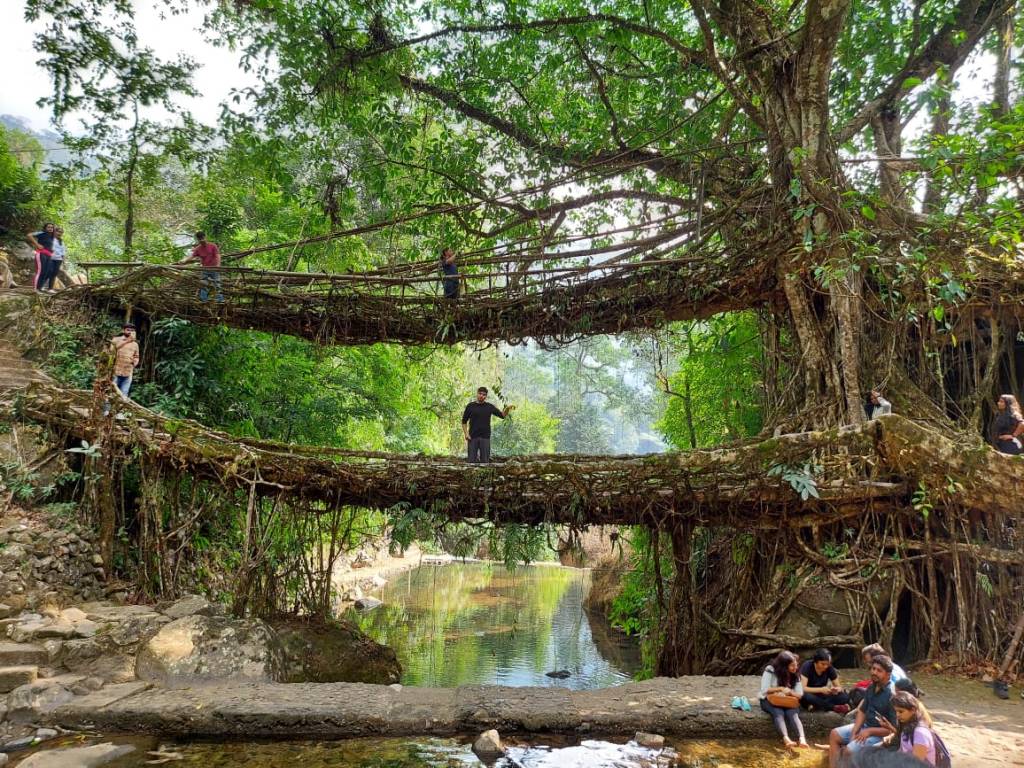
The Living Root Bridges connected the communities in the hilly terrain filled with dense forests and blessed with heavy rainfall. Now, the concrete bridges are being constructed in the villages. The Living Root Bridges found their relevance in another way. These Living Root Bridges now attract tourists and support the community by providing a livelihood. The local people earn by being guides and providing homestays. The trekking trail has many home-based restaurants and food services run by the locals.
We trekked from Tyrna Village to the sites of two Living Root Bridges. The first bridge we came across was a single bridge. The next bridge is popularly known as the Double-Decker Root Bridge. This bridge had two stories. While returning, we crossed a small Living Root Bridge. The natural beauty in the area is in abundance. While trekking, I imagined the lifeline role these Living Root Bridges played in times in these hills with dense forests where many streams ran playfully.
(Views are personal.)
 Life and Living
Leave a comment