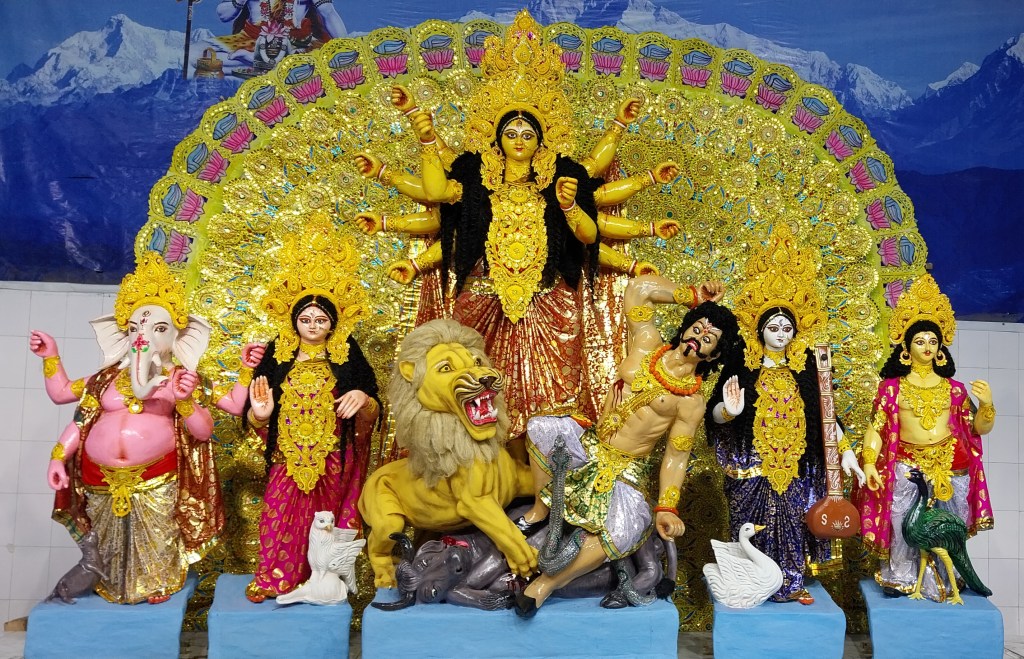
Durga Puja is celebrated each year by the communities belonging to eastern and some part of the northeastern India. The day, called as Mahalaya in Bengali, marks the beginning of the Puja. It is said that Goddess Durga descents on earth on the day of Mahalaya. The day after the Mahalaya is Prathama or the first day of Durga Puja. On the tenth day, called as Dashami, the Goddess returns to her home, Mount Kailash. There are rituals and celebrations during these ten days of Puja. Durga Puja is the main festival in Bengal. Goddess Durga is worshiped. The Puja Pandals (marquee or large tents) are installed throughout the state by the communities. The idols of Goddess Durga are placed in the Pandals. The idols of her four children- God Ganesh, Goddess Lakshmi, Goddess Saraswati, and God Kartik– are placed with Goddess Durga. The celebrations mostly start from the fifth day and ends on the tenth day.
In the year 2023, I was in Kolkata and hopped across most of the popular Durga Puja Pandals. The Pandals and the idols were epitome of creativity. This year, 2025, I was fortunate to be in Bengal during the Durga Puja. I decided to attend the rituals and other activities in the Durga Puja Pandal near my house. I had the opportunity to visit Durga Puja Pandals in different parts of India from the childhood days. The celebrations are almost on the similar lines across places.The scale of celebration varies.
The celebrations start on the fifth day (Panchami) in some places. In most of the places, they start on the sixth day (Shashti). Bodhan – the ritual for awakening the Goddess Durga – is conducted on the fifth day. In some places Bodhon is conducted on the sixth day. On the morning of the sixth day (Shasti), the ritual of Kalparambha took place. This involved making the determination to conduct the Puja during the three days. During evening, Amantran and Adhivas rituals were performed. Amantran invited Goddess Durga to accept the prayer. Adhivas is the ritual of sanctification. In many Pandals, the rituals of Bodhon and Amantran & Adhivas are followed by Ananda Mela. The Ananda Mela is a fair where the households prepare and sell homemade delicacies. In some places, cultural programs follows the Amantran ritual. The community simply had informal get-together after Amantran in the Pandal I use to visit as a child..
Saptami prayers are offered during the morning of the seventh day. A ceremonial bath, Mahasnan, is provided to nine plants bundled together in an orange coloured cloth. The plant is seated in a wooden seat, called as Pira in Bengali. Ladies tie sari (a long cloth which is draped around the body) to the plant after the ceremonial bath. The Mahasnan is followed by Pranapratishtha – the consecration and divinization of the image. This is followed by the worship of the goddess. The worship is followed by Saptami Pushpanjali. In Pushpanjali, the devotees collectively offer flowers to the goddess. They do so with the chanting of mantras. The community lunch, called as Bhog, is organized in most of the Pandals. On the day of Saptami, the Bhog is Khichdi, a dish made of rice and lentils. It also includes labra– a traditional Bengali dish of mixed vegetables. There are other side dishes too. The fun is having the meal together. The evening Aarti (worship done with lighted lamps) and the sound of Dhak (a traditional instrument/drum) evokes a sense of devotion.
On the eighth day- Ashtami– Mahasnan is done. This is followed by invoking the nine shakties of the goddess Durga through nine small pots. On the day of Ashtami, many devotees offer prayers to the goddess. The priest conducts their prayers. The Ashtami worship is followed by Ashtami Pushpanjali. This year, 2025, the time of Sandhi Puja was in the afternoon. Sandhi puja happens during the last 24 minutes of Ashtami and the first 24 minutes of Navami (the ninth day). The duration is a total of 48 minutes. At this time Durga is worshiped as Chamunda, who killed the demons Chanda and Munda. 108 lotus flowers are offered to the goddess during the Sandhi puja. 108 Diyas (the earthen lamps) and 108 candles are lighted. The Bhog on Ashtami are served after the Sandhi Puja. Puri (deep fried piece of bread made of flour), lentil and other savories are served in the Ashtami Bhog. Having Bhog with the community has its own charm. The evening Aarti along with the sound of Dhak had mesmerizing effect.
On the morning of the ninth day, Navami, the Mahasnan and Navami Puja is conducted. The puja is followed by the Navami Pushpanjali. The Bhog follows the Navami Pushpanjali. Mostly, Pilao/Pilaf/Pulao (a dish of rice cooked with spices and vegetables) is served with side dishes. The evening Aarti, the sound of Dhak and the bells invokes the feeling of devotion. Post Aarti, Dhunuchi Dance is performed. The devotees carry out this vibrant dance in front of the goddess. They carry an earthen pot with smoking coconut husk and incense called dhuna.
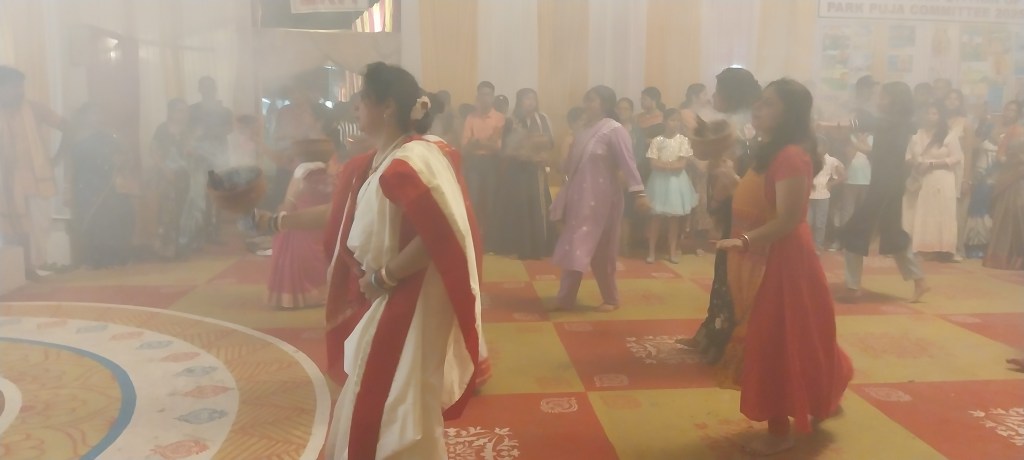
The tenth day-Dashami– observes the Dashmi Puja. This is followed by the Aparajita Puja. This prayer is offered to the victorious form of goddess Durga – The Aparajita. The priest ties the twigs of Aparajita plant to the devotees who offers their prayer. The priest thereafter circumambulate the altar and perform the Visarjan ritual. In this ritual the Goddess Durga, who was invoked and consecrated, is requested to return to her celestial abode. After the Dashami rituals, the women gather in the Pandal. They put kumkum (vermilion or red powder) to the goddess and offer sweets to her. The women also merrily put kumkum on each other. This is popularly called as Sindoor Khela. During evening, the Goddess Durga and her children is taken to the river. The devotees merrily accompany the goddess. The goddess is then immersed in the river. The sound of Dhak again invokes the feeling of strong devotion. I heard a girl saying, “We will be able to listen to this sound of dhak after a year.” A lady standing next to me said, “We feel emotional during the immersion as we spend four five days with the Goddess keeping aside our daily chores”. Holy water is picked from the spot of immersion. This is called as Shanti Jal.
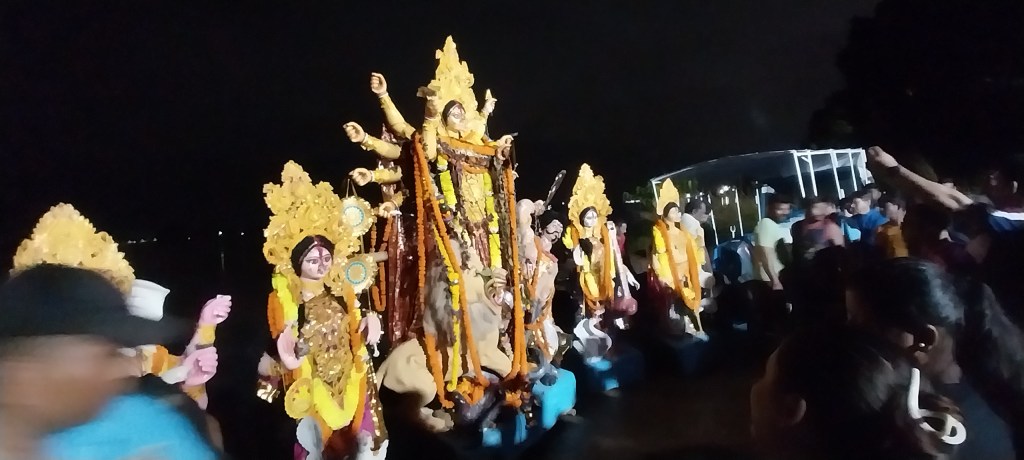
After the immersion, I, along with other devotees, returned to the Pandal. The priest sprinkled Shanti Jal to those who gathered in the Pandal, and sweet was distributed. The Pandal was the same except for the idol. Each one of us greeted each other saying ‘Shubho Bijoya’. With this, I, along with two ladies residing near my house walked back home.
A good amount of time was spent in the Pandal during the five days of Durga Puja. Almost all the families residing in the area visited the Pandal, and mostly had at least one Bhog. The community was gathered in the Pandal, had meals together, danced together, participated in the rituals together, and walked together with the idol on the day of Visarjan. For the five days, the community was woven together through the threads of rituals, prayers, laughter and meals.
(Views are personal. The write-up is based on the experiences of the Author.)


Leave a Reply