My childhood was spent in Jorhat, a small town in upper Assam. In the area where we lived, there used to be a Haat on Sundays. During the 1980s and 1990s, vegetable vendors were usually located in the main town area. Sunday haat was the only place to buy vegetables for the week in those days for us.
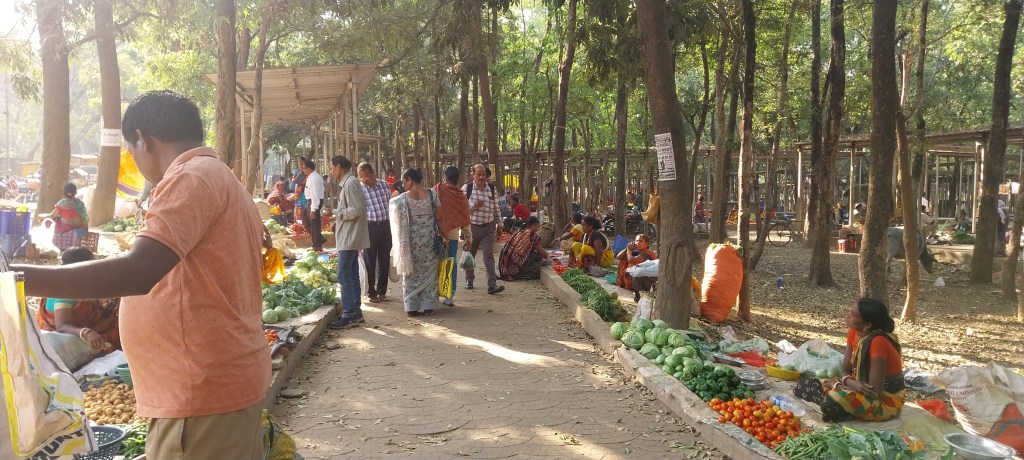
Haat is a place where, once or twice a week, the farmers from the nearby area bring their produce, mostly vegetables. Fruits and spices are also there. There is a corner for daily use items such as steel utensils, local towels (popularly called as gamcha), and other basic items. In some haats, one can see fish, chicken or other non-vegetarian food. There is a labyrinth of paths in a haat, and vendors usually sit on both sides of the path with their produce. The vendors place some polysheets or empty gunny bags to sit, and arrange their produce in front of them. In many haats, sheds are there. In some haats, sheds are not there. The infrastructure is very basic, if any. A specific area is allotted for the haat. On the days when the haat is not operational, the area looks empty.
In 1996, I went for undergraduation. With this, my visits to the haat stopped. I started my work life in 2002. For work, I travelled to many rural locations. I saw weekly haats in West Bengal, Madhya Pradesh, Assam, Uttar Pradesh and Odisha. I don’t register seeing haats in other places, but internet search and interaction with others give the understanding that haats are common in most of the states in India. During travels, I crossed haats many times, and sometimes stopped to take a look.
In 2018, I left Delhi and also my work, which included travel to rural locations. Instead, I was staying in different places, mostly away from the main town, with my husband, who had a transferable job. I visited the haat again in West Bengal, in the early 2020s, specifically to buy saplings for my kitchen garden. As there was a daily vegetable market near our place of stay, there was no requirement to go to the weekly haat. This haat was more of a weekly wholesale market.
In 2026, I shifted to a small city in Northern Odisha. There is a haat at a distance from my residence. This haat has sheds for the farmers and the vendors, and comes to life twice a week. I started going to this haat. The sellers are mostly farmers from the nearby area. A few of them travel for three to four hours to reach the haat. On interaction with a few farmers, I came to know that they harvest the vegetables early in the morning and bring them to the haat. The sellers are mostly women in Northern Odisha. The haat is full of seasonal vegetables, green leaves and flowers. The good harvest of vegetables is visible in the haat. On the other hand, one can see the distress sale of good harvest, too. The tomatoes were sold at INR 10 for two and a half kilograms, as this year saw a good harvest of tomatoes. The cabbage during the peak harvest time was sold at INR 10 for one and a half kilograms. Farmers are at a loss if the prices are very low.
Rural haats in India are the place where farmers directly sell their harvest to consumers without any middleperson. These haats are the places to know the local vegetables, fruits and food relished in that area. The freshness of vegetables, local essence and the liveliness of the rural haats are peerless. These haats has been the basic way of trade for ages.
(Views are personal.)


Leave a Reply