We moved to a small city, Rourkela, in the northern part of Odisha, about six months ago. A few days ago, on June 16, thunderstorms, lightning, gusty surface winds accompanied by heavy rains struck the city. This combination of weather events is not uncommon for the city. The power supply is disrupted whenever such weather events occur.
In the place where we reside, there are trees – not old but weak due to severe termite infestation and the poor nutritional quality of the soil. Falling of branches and trees is common in the area during storms. On the evening of June 16, a scaffold branch ( the branch arising from the stem) of the tamarind tree fell in our premises during the storm. It was almost dark, and the power supply was disrupted.
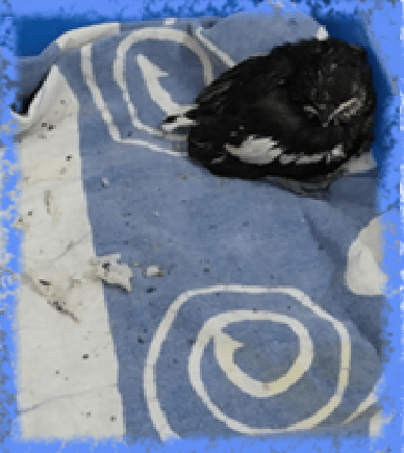
I went out to check the damage after the storm subsided. A small chick was lying secluded and drenched. There are dogs, cats, mongooses, snakes and other predators. I picked it and took it inside. I placed the chick in a small open tray with raised sides and then lined the tray with a cotton cloth. Crows dominate this area, and a few times I saw pigeons. Assuming it is a crow chick, I offered it boiled rice. The chick turned its face. It was not exactly looking like a crow chick. I realised that it is an insect-eating bird. After researching, two possibilities emerged. The chick might belong to the species of Oriental Magpie-Robin or Barn Swallow. Both are considered common in India. I had some experience with bird care. When we were posted in Assam, a neighbour used to leave their parakeets with us whenever they went on vacation. For the night, I placed it in a room where the risk of harm from rats was the least. Birds rarely eat post-sunset. I heard occasional chirping from the room.
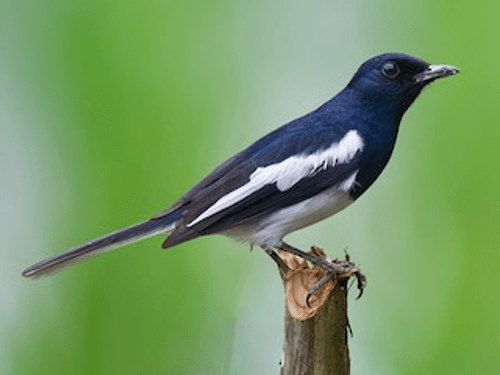
The best possible option for the magpie chick was to help it find its group. Magpies are insect-eating birds. It is difficult to raise an insect-eating bird at home. Moreover, restricting a free bird from its natural surroundings may not be beneficial to the bird in the long term.
The night passed. Early in the morning, two ladies were cutting and collecting branches from the fallen scaffold. Some households cook their meals using firewood. I went out with the intention to unite the chick with its parents. I placed the tray in the open near the fallen scaffold and watched it. The chick, who barely moved the entire night, hopped out of the tray immediately. The two ladies told me that if I keep the chick on the branch, its mother will find it out. Soon, I saw an adult Magpie moving on the ground at some distance. For the first time, I saw a magpie in the area. Due to our presence, the magpie moved away.
I placed the chick on a lower branch of a tree and watched it from a distance. Soon, the adult magpie was there. After some time, I went to the place where I had kept the chick. The chick was not there, nor was there any sign of struggle in the nearby area. I saw no predator while I was watching from a distance. I assumed that the chick moved to a safe place. However, one can never know which law of nature was at work – the instinct of the mother and chick for survival, or the law of prey and predator. A few steps away, for the first time, I saw a group of Magies on the heap of branches and twigs. They were together chasing off a mongoose. Their collective action was able to drive the mongoose away.
For the past ten years, we have been moving and living in places away from cities, mostly with natural surroundings. This allowed us to connect with nature and the animals. Many pleasant memories, and the memories of the other side of nature, remain with us. The magpie chick, a guest for the night, is a memory too.
(Views are personal.)


 Life and Living
Leave a comment